What Jesus did between Good Friday and Easter Sunday
Christians believe that Jesus Christ died on Good Friday and rose from the dead on Easter Sunday.
What did he do in the time in between?
This question has proved tempting to speculate on.
The Bible doesn’t provide much relevant information. The Gospel of Luke is explicit that Jesus ascended to Heaven on the day of the crucifixion (Luke 23.43). But is that all that was believed to have happened?
The following enigmatic passage appears at 1 Peter 3.18-20:
He was put to death in the body but made alive in the Spirit, in whom He also went and preached to the spirits in prison who disobeyed long ago when God waited patiently in the days of Noah while the ark was being built.
Many (but not all) commentators interpret this as a reference to what Jesus did between the crucifixion and the resurrection. He preached to deceased spirits from the time of Noah, when wickedness had prevailed on earth; these spirits were detained in a kind of holding cell. (Others, including Augustine and Aquinas, think that this is a reference to Christ preaching on earth through Noah to the people of Noah’s time.)
What was the preaching? Was Jesus bringing the spirits a message of salvation? Many commentators have been uneasy with the idea that Noah’s generation got a second chance to be saved (even though the apocryphal work known as the Book of Enoch seemed to suggest that they would indeed get such a chance). Maybe Christ preached only to the spirits of the righteous. Maybe the people to whom he preached had already repented at the hour of their death. Or maybe he ‘preached’ damnation to the spirits and not salvation.
Other theories were available too. Maybe the beings preached to were the fallen angels of Genesis 6. Maybe they were evil spirits who were active in Noah’s time and are still active in the world today, and Jesus was proclaiming to them his sovereignty over them.
Last year, I wrote about the story of the resurrection of the holy men in Jerusalem. The idea that Jesus preached to the spirits came to be combined with this story, although the Biblical text does not connect them.
*
In developed medieval theology, these ideas came to be rolled into the legend of the Harrowing of Hell. In summary, it was believed that Jesus went after his crucifixion to a place called the limbus patrum, or limbo of the fathers, which was where the righteous people who had died before his coming resided.
The Harrowing of Hell was a popular theme in the Middle Ages. It came to be depicted in artworks, such as this one by Fra Angelico. Jesus was English, so he is carrying the England flag:
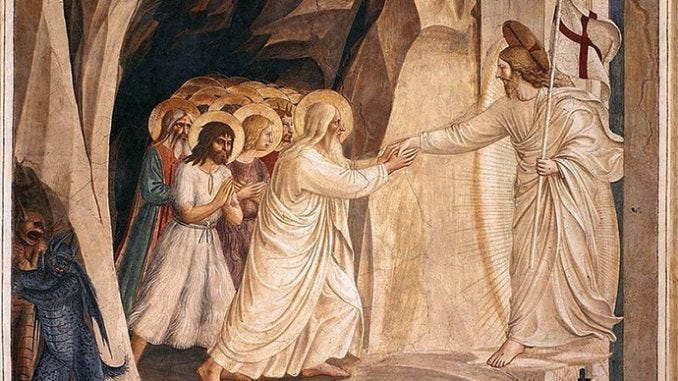
The Harrowing of Hell must have been an extraordinary dramatic episode. What exactly was thought to have happened?
A major source on the subject was the apocryphal Gospel of Nicodemus, which was written in the early centuries of the church. It is not a first-rate literary production, but it has a definite interest and deserves to be better known. The relevant part of the Gospel purports to be the sworn testimony of two sons of the New Testament character Simeon, who were resurrected in Jerusalem along with the other righteous dead.
Let’s have a look at what the text says.
The souls of the dead are in Hell, when suddenly golden and purple light appears, dispelling the blackness.
Adam and the prophet Isaiah tell the righteous dead that the promised Messiah has come. The righteous souls begin to rejoice; and Adam and several other Biblical figures address them.
Meanwhile, Satan speaks to his henchman Beelzebub, the ‘Prince of Hell’. He recognises Jesus as his old enemy: “those whom I made blind and lame and those also whom I tormented with several devils, he cured by his word”.
Less edifyingly, Satan also says that he tried to cause trouble for Jesus by stirring up “my old people, the Jews”.
He tells the Prince of Hell that it is Jesus who raises people from the dead. The Prince tells Satan not to bring Jesus to him because he will liberate the inmates of Hell.
Now comes the entry of Jesus. The Prince sends Satan away contemptuously and orders his minions to close the gates of his realm.
But the righteous dead respond by rising up. King David and Isaiah reiterate the prophecies ascribed to them in the Bible.
The voice of Jesus is heard demanding to be let in, and presently he appears in the form of a man.
“And [he] broke asunder the fetters which before could not be broken; and with his invincible power visited those who sate in the deep darkness….”
The narrative turns to Death and her servants. They are seized with fear. Who is this extraordinary being? “Who art thou, so powerful and so weak, so great and so little, a mean and yet a soldier of the first rank, who can command in the form of a servant as a common soldier?”
The demons of Hell are in terror as Jesus seizes hold of the Prince of Hell and deposes him from his position.
The Prince is angry with Satan: “as a fool [thou] wert ignorant of what thou wast about”. He remonstrates with Satan for crucifying Jesus “without either reason or justice”. The results have been terrible: “He has broke down our prisons from top to bottom…. Our impious dominions are subdued, and no part of mankind is now left in our subjection…. Though, before, the dead never durst behave themselves insolently towards us, nor, being prisoners, could ever on any occasion be merry.”
The Prince tells Satan that he will now be damned; and Christ duly gives him power over Satan in Hell.
Jesus declares: “Come to me, all ye my saints, who were created in my image, who were condemned by the tree of forbidden fruit, and by the devil and death”.
Adam worships him, followed by the other righteous dead. Jesus makes the sign of the cross over them. “And taking hold of Adam by his right hand, he ascended from Hell, and all the saints of God followed him.” David and Habakkuk quote from their Biblical writings.
Jesus now delivers Adam to the Archangel Michael, who leads all the saints into Paradise. They find Enoch and Elijah already there: based on the prevailing interpretation of the Old Testament, they had been taken directly up into Heaven when their earthly lives were completed. “Here we have hitherto been, and have not tasted death, but are now about to return at the coming of Antichrist, being armed with divine signs and miracles….”
The text goes on to describe the salvation of St Dismas, the ‘Good Thief’ of the Gospels.
*
A happy Easter to all my readers.
 Dr Robin Douglas