Originally posted on 4 April 2025.
This is a slightly edited version of the paper that I delivered last Sunday at the Contemporary Antisemitism 2025 conference in London.
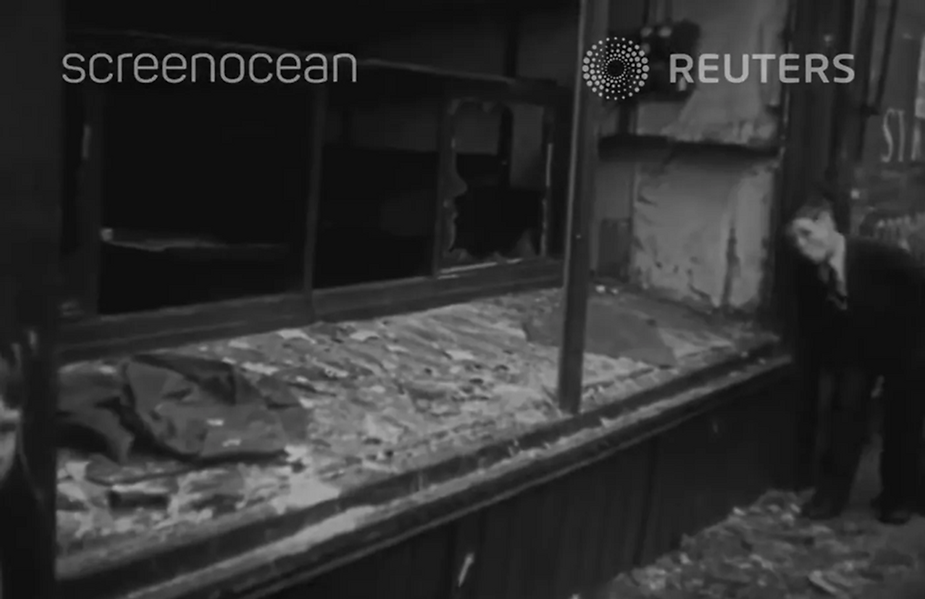
The last outbreak of mass anti-Jewish violence in Britain took place in August 1947. It is almost entirely forgotten today. It is virtually never mentioned in public discourse. It has been largely neglected by scholars. There is only one dedicated academic study on the episode, a book chapter by Tony Kushner of Southampton University which appeared in the 1990s. Beyond that, there are a small number of journalistic articles, but not much else.
The reasons for the neglect of this episode would make an interesting subject of research in themselves. For present purposes, I am concerned with the insight that the 1947 riots can provide into how quickly large-scale physical violence against people and property can break out if a certain combination of circumstances come into alignment: casual antisemitism, economic discontent, and a pretext provided by war in the Middle East.
Background
First, a few words of background.
There have been three anti-Jewish pogroms in modern Britain. The first was in 1911, in South Wales. The second was in 1917, during World War I, in Leeds and London. The third, which is the subject of this paper, took place in August 1947, and it involved incidents across the country. None of these episodes has been given sufficient attention in either academic or popular writing.
The riots in 1947 were precipitated by a grim series of events in Mandatory Palestine which have become known as the ‘Sergeants’ Affair’. The British Army was fighting one of its brutal late-imperial wars; and not only fighting but losing. The British Government would shortly take the decision to pull out of Palestine; that decision was taken on 20 September. In the meantime, the war had threatened the position of Jews in Britain: many Britons had felt able to indulge old prejudiced tropes. Many assumed that British Jews were not fully British; they could be conflated with the fighters in the Middle East, and they could be required to engage in conspicuous displays of loyalty to Britain that were not demanded from any other community.
What was the Sergeants’ Affair? In summary, the Irgun attacked Acre Prison, and as a result three of its fighters were sentenced to death. The Irgun then captured two sergeants from the British Army Intelligence Corps, and hanged them in reprisal. The bodies of the two men – Mervyn Paice and Clifford Martin – were discovered in a wood near Netanya on 31 July, and a third British soldier was injured by a booby trap at the scene.
The killing of the sergeants was a highly controversial act. Menachem Begin later said that it was the most difficult decision that he had made in the war. Most of the Yishuv disapproved of the killings, and the Haganah assisted the British authorities. In Britain, the Jewish community seems to have been effectively unanimous in condemning the action.
The reaction in British gentile circles was one of outrage. Members of British forces carried out revenge attacks in Tel Aviv and killed five people. And the violence was quickly exported back to Britain. A key role here was played by the press, and in particular by the Daily Express, which splashed the news of the sergeants’ deaths across its front page, complete with a large inflammatory photo.
Ernie Bevin, the Foreign Secretary and a man who was no stranger to antisemitism himself, told the American secretary of state that “anti-Jewish feeling in England was now greater than it had been in a hundred years”.
The course of the riots
As to the course that the riots took, no-one to date has attempted to compile a full chronology of events, so I have compiled one myself and posted it on my Academia account.
In summary, rioting against Jewish targets began in Liverpool and Glasgow on Friday 1 August. It then escalated over the weekend. That fact that it happened to be a Bank Holiday weekend didn’t help matters. There were major disorders in different parts of the country on the Saturday, Sunday and Monday. The main centres of the disturbances seem to have been Liverpool and Manchester. From Tuesday 5 August, the incidents began to die down; but it took several days for order to return.
The principal targets of the rioters were Jewish-owned properties. Many windows were smashed, and there were incidents involving arson. Personal violence against Jews was also reported. There is evidence that at least 12 people were assaulted, nine or more of whom were Jewish. There was one reported fatality, when an 80-year-old woman with heart trouble died after her premises were attacked. There are reports of stone-throwing; and an attempt to burn down a synagogue with people inside; and two incidents in which individuals apparently planned to shoot Jews.
The obvious question is: why? The riots took place in the aftermath of the defeat of Nazism, at a time when the Holocaust was still a recent memory. Why did thousands of British people in locations all over the country feel able to treat their Jewish fellow-citizens in the way that they did?
Explanations
One explanation that we can discount immediately is that the rioters were sincerely concerned about the fate of Mandatory Palestine. These were people who would have struggled to find Palestine on a map. Most of them would have known little or nothing about who the Irgun were. They would probably never have heard of Begin; or indeed of Ben Gurion; or of the differences between the two men and their aims. In Liverpool, one rioter was quoted as shouting at local Jews, “You dirty bastards, you should be in Palestine” – which is a bizarre way to express outrage at the actions of a Revisionist Zionist militia.
There was in any case no rational basis to the idea that terrorising British Jews could help the situation in Palestine. The prominent Jewish politician Gerald Isaacs, Marquess of Reading, commented ironically in the House of Lords that they were the last people in the world whom the Irgun would be willing to listen to. Moreover, as one newspaper sardonically commented, if the rioters were truly concerned about the breakdown of law and order in Palestine, no-one was stopping them from enlisting in the colonial police. But they didn’t do that. They stayed in Britain and attacked their Jewish neighbours.
Perhaps economic factors played a role. Already at the time, some people were inclined to explain the riots in this way, against the backdrop of postwar austerity in general and the 1947 Sterling crisis in particular. Tony Kushner’s piece on the riots emphasised the role of economic conditions in fomenting them. He noted that the main centres of the disorders – Liverpool, Manchester and Glasgow – did not have a history of antisemitic rioting, yet they did happen to be the areas that were worst hit by unemployment.
The economic explanation for the riots does not entitle us to write antisemitism out of the picture. The two things go hand in hand. Economic hardship is a well-known breeding ground for irrational hostility towards Jews. We may add to this the continuing effects of antisemitic rumours. There had been claims during the war that Jews were black marketeers and war profiteers; and, later, claims that they had been hoarding fuel during the fuel crisis of 1946-47.
Who were the rioters?
Who were the rioters? As it happens, we know a certain amount about them. Some useful information is contained in reports of court cases that followed the riots. In broad summary, the rioters tended to be young, working-class and male. A significant number of them seem to have been minors.
There was a temptation among some people at the time to write them off as mere hooligans – people who decided to entertain themselves on a Bank Holiday weekend by getting drunk and smashing things up. There is probably an element of truth in this. But yet it was the Jewish community, specifically, that they singled out, and that makes it difficulty to put the riots in the category of hooliganism. This wasn’t just mindless thuggery. It was something else.
And so we come to antisemitism as an explanation for the riots. But here we have to make an important distinction. The most significant thing about the rioters – in my view – is that they were not ideological antisemites.
By ‘ideological antisemites’, I mean people who had an explicit, fully-formed hostility to Jews, whether in the form of Christian prejudice against supposed killers of Christ or Fascist prejudice against supposed racial enemies. In other episodes of mass anti-Jewish violence – the pogroms of Tsarist Russia, for example, or the anti-Dreyfus riots, or Kristallnacht – a key role was played by ideological antisemitism of this kind. But not in the 1947 riots.
There is almost no evidence that the rioters were motivated by Christian religious bigotry, and only limited evidence that they were motivated by Fascist beliefs. There was a Fascist movement in Britain at this time – it revived remarkably quickly after the defeat of the Nazis – but it did not cause the riots. Sources in the police and the Jewish community at the time agreed that the riots were not orchestrated by Mosleyites. One Jewish community leader in Manchester estimated that only about 5% of the rioters were Fascists. Fascists certainly used the killings of the sergeants in their propaganda – and they tried to exploit the riots for their own purposes – but they did not cause them. The riots cannot be written off as the doings of far-right extremists.
Ideological antisemitism was unusual in Britain at this time, and it was correspondingly rare among the rioters. But casual antisemitism was not. We are talking here of half-understood, half-submerged prejudices which were too incoherent to rise to the level of an ideology. ‘Jews are different. They’re not like us British. They only look after themselves.’ These prejudices were only too common in Britain in 1947, and they had been inflamed by the war in Mandatory Palestine. It was these seemingly vacuous prejudices that formed the bridge between Irgun militants killing British soldiers in Netanya and young men setting fire to Jewish-owned shops in Liverpool. We are dealing here with primitive fears and hatreds. The rioters were marking and enforcing an identitarian boundary. The fact that their prejudices were vacuous – and that they were formed outside of a recognised antisemitic tradition like fundamentalist Christianity or Fascism – did not make them any less dangerous.
The forgetting
Discussion of the riots in British society stopped very quickly – although racist violence did not, with anti-Black riots breaking out in Liverpool just a year later. There was briefly pressure in Labour circles for the Government to order an inquiry into antisemitism; but this did not happen.
The riots threatened the self-image of a country that had just won a global war against Fascism. Several public figures commented rather nervously that the riots were un-British. Within the Jewish community, there was a sense of pain and betrayal, particularly among Jews who had fought in the armed forces. One sign in Manchester read: “As a British sailor I fought for you. This is my reward.” Another sign in the same city stated the family’s war record while denouncing the killing of the sergeants.
There is no mystery about why most people today have never heard of the 1947 riots. For all concerned – both inside and outside the Jewish community – it was easier to forget than to remember.
Conclusion
By way of a conclusion, I would suggest that the truly disturbing thing about the 1947 riots is the lack of ideological antisemitism among the rioters. They weren’t Nazis or Christian fanatics. But they didn’t need to be. The half-formed, incoherent prejudices that they had about Jewish otherness and Jewish self-interest were enough – enough to authorise them to leave their homes, throw stones at Jews, smash their shop windows and set fire to their property.
The 1947 riots teach us that Jewish safety in the diaspora is imperilled not only by ideological antisemitism but by the most vacuous casual prejudices. The other lesson of the 1947 riots is that the safety of British Jews is imperilled when thugs in Britain feel entitled to conflate them with combatants in a war in the Middle East.
 Dr Robin Douglas