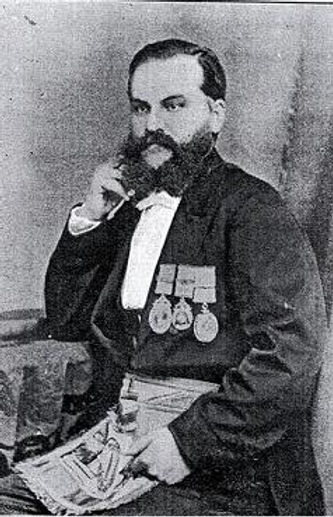
This is an article about an undeservedly forgotten figure of the nineteenth-century Occult Revival – a colourful character by the name of Francis George Irwin (1828-1893).
Irwin was an Irishman who ended up living in Bristol in England. He probably came from a Protestant family. He spent his career as a soldier, but for present purposes we are interested in his extra-curricular activities.
Irwin’s main hobby was Freemasonry. This was not in itself unusual for the time. Lots of men in the nineteenth century were Freemasons. But Irwin did not stop at the mainstream Masonic movement. He joined – and in some cases founded – a whole series of Masonic orders over the course of his lifetime. These included exotic sects with names like ‘the St Aubyn Red Cross Council’, ‘the Royal Order of Eri’ and ‘the Rite of Swedenborg’. According to Irwin’s Masonic obituary address, “so great was his desire to obtain more light, that there was scarcely a degree in existence, if within his range, that he did not become a member of”.
Within Freemasonry, there was a long-established current of interest in esotericism, and Irwin was very much part of this current. He was heavily involved in the occult scene of the day. He was a member of the Societas Rosicruciana in Anglia (SRIA), an esoteric Masonic group which had an important place in the Occult Revival. He attempted, not very successfully, to set up his own magical order, called the Fratres Lucis (c. 1874-76); and he ran, again not very successfully, a publishing business by the name of the Rosicrucian Press (1876-79). The one occult endeavour that Irwin wasn’t involved in was the most influential esoteric order of all, the Hermetic Order of the Golden Dawn. It is not clear why Irwin didn’t join the Golden Dawn: it was probably because he didn’t get on with William Westcott, one of its principal leaders.
*
The subject of this article is a fascinating text entitled ‘Hymn to the Sun’ which Irwin composed in 1889. I found it in the library of Freemasons’ Hall in London.
The Hymn formed part of the rituals for a new Masonic order which Irwin was thinking of setting up. This was to be called the ‘Order of the Brotherhood of Plato or the Mysteries of Egypt’.
Most of the rituals that Irwin drew up for the order derived from the prologue to a French play (Les Francs-maçons, 1867) which depicted the Greek philosopher Plato being initiated into the mysteries of the Egyptian priesthood. The play was apparently never performed, but it ended up being translated into English by the Masonic occultist John Yarker, and this is presumably how it found its way to Irwin.
It must be emphasised that the Hymn was not contained in the French play. It is an original composition by Irwin.
At this point, we may quote the text of the Hymn in its entirety. It has not been freely accessible on the internet before now.
Inextinguishable fire! inexhaustible source of Light + color — to thee the most beautiful ornament of the Heavens, + the first of the benefactors of the Earth! Eye of the world! Painter of nature! Architect of the universe
Nuk pe Nuk *— all Hail –
Sun! it is to thee that the nations have erected their first altars — man ought never to have erected altars but only to Thee Divinity of the twelve wings — for the twelve great Gods are born of the Zodiac that thou perambulatest Nuk pe Nuk — all Hail –
Sun! Thou art not the all, thou art not God — thou art not our infinite + invisible Osiris, but the invisible Osiris discloses himself in thy disc, thou art the brilliant unity only capable of making us comprehend the Grand unity which compasses all, thou art the first of our Gods — thy religion is universal Sun thou art the Alpha + Omega of all things
Nuk pe Nuk — all Hail –
Sun the Phoenicians call thee Beelsamon — or Adonis + sometimes Hannible, or the unique — the Persians Mithra — the Greeks Apollo, or Bacchus or Hercules — among others Belenus or Jupiter in our Egypt sometimes Serapis — thou art the Saturn of the Arabs — and the God Ammon of Lybia, thou art the Belus of the Euphrates — the circle God of the town of the Palms — and the Apis of the Nile
Nuk pe Nuk — all Hail –
But the only name which becometh thee, and which becometh thee only is that of the brilliant God thou alone art all the Gods, thy light is the providence of the globe, Sun thou art the Grand Abraxis or Saviour of the universe — thou art Elias the ancient of all Gods and Kings.
Nuk pe Nuk — all Hail –
Brilliant phoenix of this globe! Sun! it is thee alone that all the nations adore, without knowing thy attributes, but thy names attest that the only, Sol is Solus, the Divinity the Delphos of the Greeks thou hast taken the precedence of all the objects of religion amongst mortals, and thou wilt survive them — man has augmented through thee. he will also terminate through thee — Sun! It is from thee and within our schools that our Homer borrowed that chain of gold which unites Earth with Heaven — each of thy rays is only an effect a link of this golden chain by which the attractive force compels the planets to move on in their undeviating course which thou hast traced for them around thy brilliant disc
Nuk pe Nuk — all Hail –
What a sublime conception reveals itself to us, if we consider that in the immensity of Nature each of these stars which scintillate in the blue vault of heaven during the night may be another sun — similar to thee and thine equal in power and beauty — who can measure the illimitable extent of nature? It is only given to thee to traverse away upon the Grand Circle of Life
Nuk pe Nuk — all Hail –
[* = What does this phrase mean? It appears that Irwin thought that it was the Egyptian equivalent of the biblical “I am that am” (Exodus 3.14). It is only loosely accurate. It seems to be an attempt to say ink pw ink, which is itself an ungrammatical variation on the phrase ink pw (“it is I”). The latter phrase would have been pronounced as something like anok pu. The earliest documented occurrence of the phrase “Nuk pe Nuk” was in an alleged supernatural communication received by the prominent Spiritualist Rev. William Stainton Moses, who moved in the same occultist and Masonic circles as Irwin.]
The theology on show here is a kind of ‘soft’ monotheism with characteristics of polytheism. The gods of the different ancient pantheons are seen as legitimate beings insofar as they are expressions of the sun – the “Architect of the universe”, as Irwin puts it in a classic Masonic phrase. It subsequently becomes clear that the sun is the symbol or self-revelation of the invisible Osiris, who is the ultimate godhead – the “Grand unity which compasses all.” This phrase has pantheistic or panentheistic overtones, although these are not developed by Irwin.
The concept of soft monotheism based on the sun was not invented by Irwin in the 1880s. It had ancient precedents. In later antiquity, there was a general tendency towards a kind of syncretistic monotheism which was linked with sun worship. This trend grew stronger over time, especially from the reign of the Roman emperor Aurelian (270–275 CE). This kind of solar monotheism could provide a bridge to Christian theology. It seems to have done so, most famously, for the emperor Constantine, who is known to have had a devotion to the sun gods Apollo and Sol Invictus before his conversion to Christianity (and perhaps also afterwards).
Moving forward in time, in Irwin’s beloved Freemasonry the sun is a symbol of basic importance. It became the subject of mystical rhetoric, as well as theories about the supposed descent of Masonry from ancient sun worship. One branch of the Craft even developed a specific degree of ‘Priest of the Sun’. Some of this speculation seems ridiculous today. Not many present-day scholars would follow the antiquarian Godfrey Higgins in arguing that “Free Mason is PH-RE – PH the Coptic emphatic article and re the sun, Mason of the sun.” But such ideas were taken seriously at the time. Tom Paine, for one, believed that the Masons descended from ancient sun worshippers.
(It is only fair to say that these strands within Freemasonry did not go unchallenged. Other Masons disliked sun worship and the idea that their fraternity had pagan origins.)
Oddly enough, the roots of Irwin’s Hymn can also be traced back into a fairly extensive tradition of historical scholarship. There is book-learning behind the text. By the time that Irwin was writing, there was a well-established set of scholarly theories that linked the religion and mythology of ancient pagans with the sun. In many cases (but not all), these theories were aimed at debunking Christianity: Christ was revealed as just another solar god. This intellectual current originated among writers of the eighteenth century: in particular, two French revolutionaries called Volney and Dupuis, and also a conservative British Christian called Bryant. These men and their ideas continued to be enormously influential in the nineteenth century, when they were supplemented by a new wave of interest in theories tracing the origins of ancient mythology to the sun. This new wave was associated in particular with the German-born Oxford scholar Friedrich Max Müller. To this extent, Irwin was writing within the intellectual mainstream of his time.
Irwin was at least notionally Christian. But his Hymn shows how a path could be constructed between conventional Christian belief and revived paganism. As a first step, the exclusive monotheism that was traditionally taught by Christianity could be elided into the nonsectarian monotheism that Irwin was familiar with from Freemasonry. This nonsectarian monotheism could then be evolved further into a syncretic idea of the divine in which polytheistic deities from the ancient pantheons could be invoked by name as expressions of the one underlying God. That is what Irwin is doing in the Hymn. Recognising the legitimacy of specific polytheistic gods made it thinkable to worship those gods directly as discrete personalities. The final step was to worship only those polytheistic gods, while downplaying or abandoning the ultimate monotheistic deity that stood behind them. This final step was taken by Gerald Gardner, the founder of the revived witch religion of Wicca:
[Witches] quite realise that there must be some great “Prime Mover,” some Supreme Deity; but they think that if It gives them no means of knowing It, it is because It does not want to be known…. So It has appointed what might be called various Under-Gods, who manifest as the tribal gods of different peoples; as the Elohim of the Jews, for instance… Isis, Osiris and Horus of the Egyptians… and the Horned God and the Goddess of the witches.
*
If you were a Protestant living in Victorian Britain and you were getting into occultism, you would not have had many obvious sources of esoteric ritual available to you. (Things were obviously different in Catholic and Orthodox cultures.) But, if you were a man, you would have had at least one such source available to you – Freemasonry.
Freemasonry is not a religion: it just looks and feels like one. It has had enormous influence on the development of modern esoteric and pagan traditions, notably through two Victorian occult societies, the Golden Dawn and the Ordo Templi Orientis (OTO). As it happens, this influence also extended to Gerald Gardner’s Wicca. As I wrote in Paganism Persisting, the history of pagan revivals that I co-authored with the distinguished scholar Francis Young:
A middle-aged businessman in a suburban Masonic hall may be initiated into ‘the craft’, undergo being blindfolded and stabbed with a sharp object, swear an oath, encounter ‘working tools’ and hear a ‘charge’, all while his teenage daughter goes through the same experiences in the coven meeting next door.
Masons, occultists and pagan witches might not look on each other as kindred beings. But then the history of religions sometimes uncovers strange bedfellows. This brings us back to Francis George Irwin, who stands as a fascinating example of the crossover between the conservative bourgeois milieu of Freemasonry and the eccentric world of occultism. He has not received a great deal of attention from historians to date: he ought to be better known.
 Dr Robin Douglas